Returns have become a normal part of the shopping experience for many consumers. As online shopping continues to grow, many customers are buying multiple versions of the same product (different sizes, colors, styles, or feature options). Upon receiving their order, customers will usually test out each product to determine which one best suits their needs and return the other products that they do not wish to have. This is called bracketing. Bracketing is most common for:
- Clothing
- Shoes
- Technology devices
- Home goods
- Furniture
- Beauty & Cosmetics
- Accessories & Eyewear
- Sporting goods & Gear
Common return process bottlenecks typically fall into four areas: limited inventory visibility, slow customer refunds, unclear rules for items awaiting a decision, and time-consuming manual data entry. In the old model, incoming returns are interspersed with new supplier goods on the dock. Since the supplier’s goods are more valuable, the returns tend to get pushed aside and accumulate. An effective returns management process is a necessity in the current market. A warehouse management system (WMS) removes return management bottlenecks. A WMS automates return merchandise authorization (RMA), guides the dock intake process, and determines disposition by automatically routing items to restock, refurbish, or to be recycled. Your receiving teammates can be proactive and prepared for the intake by having the WMS automatically: 1) register the inbound RMA, 2) map out space at the dock, and 3) schedule labor based on predictable return volumes. The image below illustrates a high-level returns process:
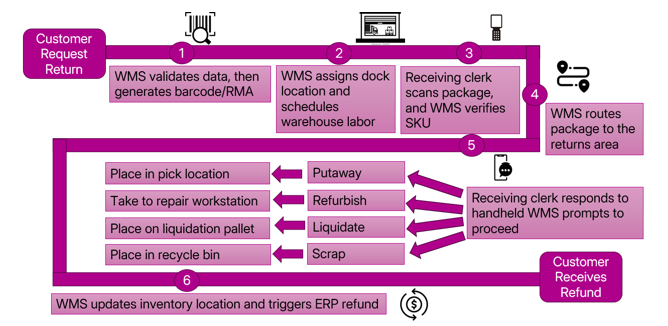
Rather than opening random boxes blindly and trying to guess the order contents, your receiving teammates can simply scan the pre-generated carrier barcode to instantly pull up the customer’s order history, reason for return, and pre-assigned grading workflow. With this visibility, they can immediately route incoming pallets to a dedicated reverse logistics area, while keeping the primary receiving lanes open and clear for profitable supplier inventory. Shifting to this workflow changes the mindset of your dock from reactive mode (fighting the fires of unexpected backlogs) to proactive mode (perfect staffing levels that match the day’s inbound processing events). The biggest bottleneck is typically decision-making. A WMS automates the decision-making process with predefined business rules that immediately determine:
- Putaway: Flawless items are put into a picking bin.
- Refurbish/Repair: Items with minor flaws are routed to a tech workstation.
- Liquidate/Donate: Out-of-season or open-box items are placed on a liquidation pallet.
- Scrap: Damaged items are sent to recycling.
As soon as the WMS makes a disposition decision, it updates your inventory levels in real time across all sales channels. If the item is deemed acceptable for resale, it is already online again and ready to be purchased by another customer, increasing its likelihood of being resold at full price.
Ultimately, this workflow decreases your dock-to-stock times, preparing your returns for resale before they have a chance to sit and depreciate. By making unexpected inbound surprises become scheduled, predictable events, your team eliminates the dock congestion that has traditionally paralyzed warehouse productivity. Your dock crew will spend less time solving mysteries and more time keeping inventory flowing through your facility.
With an automated reverse logistics process, returns can go from being a headache to a competitive differentiator. Automation connects the disconnect in the reverse logistics process between receiving and re-selling, so returned products no longer drag on warehouse profits and productivity. Automating and streamlining the steps between the loading dock and the e-storefront ensures that the company’s bottom line is protected, its warehouse productivity is at full tilt, and customers receive the quick, hassle-free turnaround that today’s consumer demands.
—Ashley Rhodes, St. Onge Company