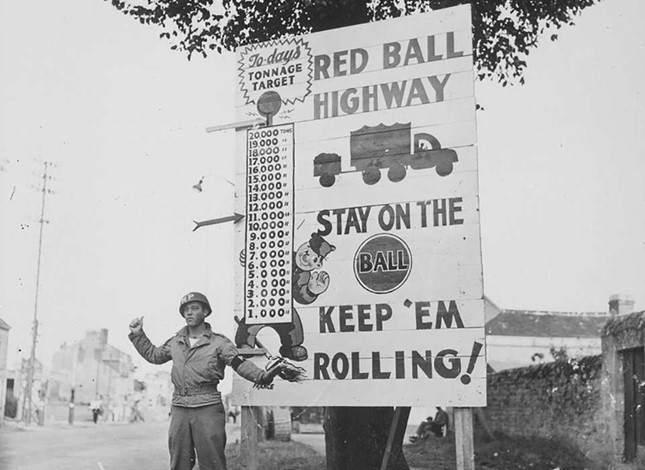
While we may be fascinated by historical events and enjoy learning about the experiences of generations past, we often view history as outdated, obsolete, and with little application to the present day. But when we consider supply chains in the present day, we can be mindful that such challenges are not a new phenomenon. In an extreme example, consider the extraordinary efforts to supply the American and Allied Forces in World War II that came to be known as the Red Ball Express.
The term “Red Ball” originated in 1892 with the Santa Fe railroad and referred to expedited shipping used to move high priority goods like perishables on rail lines marked with red balls. The term “Red Ball Express” was then aptly applied to the trucking convoy that is responsible for supplying the success of the American and Allied forces toward the end of WWII.
In the summer of 1944 Allied forces successfully landed on the beaches of Normandy. After struggling to break out from coastal areas, the Allies began pushing eastward through France in the European Theater. Prior to the D-day landing in Normandy, Allied forces had bombed French railways and bridges, rendering them inoperable and hampering the ability of German forces to send reinforcements and supplies westward. With momentum shifting and the Wehrmacht in retreat, those same modes of transportation were also useless to the attacking Allies in their push eastward. To make matters worse, Allied efforts to retake the deep-water port of Antwerp, Belgium has thus far been unsuccessful. General George S. Patton’s US Third Army began spearheading through German lines with lightning speed, often more than 80 miles per day, leading to significant supply problems for the fast-moving fighters. The “tail of the inchworm” needed to catch up to the head.
After 36 hours of planning, the critical trucking route began operating on August 21, 1944 and ran continuously for 82 days until November 8th, when the port city of Antwerp was finally under Allied control and sufficiently repaired. Fuel, food, and ammunition in large quantities were unloaded in the western French port of Cherbourg and trucked through often muddy narrow country roads to supply depots in Chartres, La Loupe, and Dreux. Brigadier General Ewart G. Plank was tasked with implementing the improvised Red Ball Express about which he famously remarked “Let it never be said that [a lack of supplies] stopped Patton when the Germans couldn’t.” Over 6,000 trucks driven by team truck drivers with little to no training drove the 54 hour round trip, completing a one-way circuit to the frontlines and back to the French coast. 73% of the drivers were African American, who were at the time relegated to supply and support roles. They ultimately proved invaluable to supply chain and the war effort in general. Speeds often exceeded 60 miles per hour, much faster than the planned 25 mph. Accidents, equipment failure, extreme fatigue, land mines, mud, and attacking Luftwaffe enemy aircraft were just a few of the hazards the convoys faced with regularity along the way. In the end they transported an estimated 12,000 tons of supplies per day without which Allied success would have been impossible. Time magazine later called the Red Ball Express the “Miracle of Supply” from its stateside source point to the front lines in the European Theater.
While modern companies may not have to deal with landmines and strafing from enemy aircraft along vital supply routes, logistical challenges are nonetheless constant. Those with contingency plans, and the ability to pivot when supply routes change will be best positioned to compete over the short and long term. Just as the Allied forces struggle against the Nazis in 1944 most assuredly would have failed without a determined and improvised supply chain, so too will modern businesses fail without adequate preparation and adaptation for challenges ahead. Perhaps it is time for your business to consider optimizing its supply chain network, and engineering plans for resilience and sustainability.
—Eric Payne, St. Onge Company
Sources:
https://www.nationalww2museum.org/war/articles/red-ball-express
https://transportation.army.mil/history/studies/red_ball_express.html