In today’s economy, supply chains must be agile and adaptable due to unpredictable shifts in demand. To navigate uncertainty, leading organizations rely on robust change management strategies to ensure smooth transitions. Many organizations invest heavily in system upgrades or automation tools, but overlook the people and processes that make these systems effective. In fact, research shows that up to 70% of large-scale transformations fail — not because of poor technology, but because of poorly defined change management, causing change fatigue and frustration. Proper change management minimizes disruption and enhances project success rates, helping organizations meet their long-term operational goals while maintaining morale. Effective change management strategies include the following:
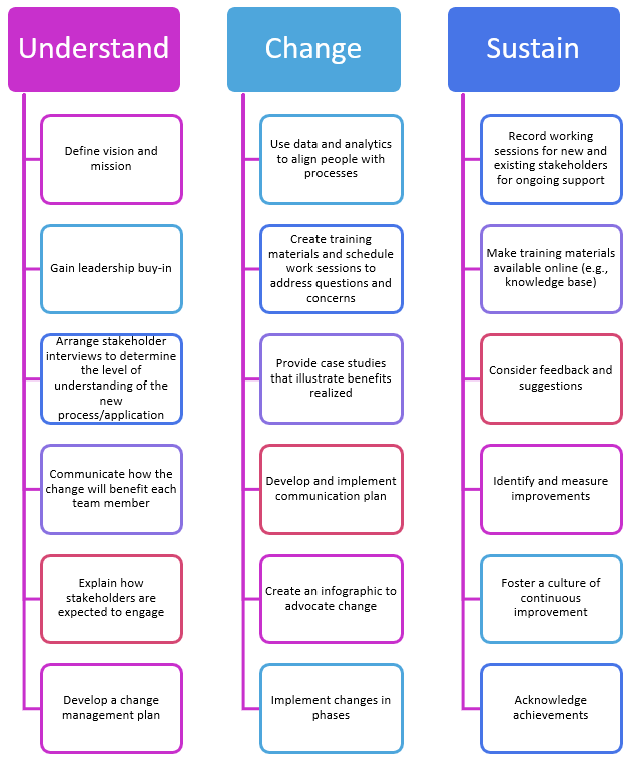
Change starts with clarity. People tend to support what they understand, and involvement drives acceptance. Employees who help shape the process are more likely to commit to it. To build trust and high morale, communication must be continuous. When done well, change management turns disruption into growth. Without proper change management, employees may resist new processes, and organizations can fall short on projected ROI expectations. It’s important to understand that resistance to change is natural. Leaders should approach uncertainty with empathy by listening to concerns, clarifying misconceptions, and highlighting success stories. Communicate how employees can receive tangible benefits with improved processes and increased supply chain visibility. Keep in mind that employees must embrace new workflows, managers must realign KPIs, and suppliers must adapt to new standards. Without structured change management, even the best strategic initiatives can stall due to miscommunication, resistance, or confusion. Organizations that integrate change management into their transformation projects enjoy several key advantages, including faster adoption, higher productivity, stronger alignment, and sustained improvement.
Changes in supply chain that require an effective change management strategy include:
- Implementing a new system or technology (e.g., warehouse management system, cloud migration)
- Reshaping supplier networks (e.g., diversifying suppliers)
- Introducing automation (e.g., new equipment)
- Organizational and structural changes (e.g., mergers, acquisitions)
- Cultural shifts (e.g., moving from waterfall to agile)
- Adopting sustainability initiatives (e.g., carbon tracking)
Change management bridges the gap between vision and execution, ensuring that innovation delivers measurable results. People power the supply chain, and successful change starts at the top. Leaders must communicate a clear vision, model the desired behaviors, and remain accessible during transitions. When executives and managers demonstrate commitment by using new systems themselves or publicly recognizing team progress, it builds trust and momentum across the organization. Moreover, involving cross-functional teams early ensures that change isn’t perceived as an “IT project” or “management mandate.” Instead, it becomes a shared initiative that empowers employees to improve how they work. Once a change has been implemented, the real challenge begins: sustaining it. Reinforcement through ongoing training, KPIs tied to adoption, and continuous improvement programs ensures new behaviors stick. Regular communication about benefits and results, such as faster order fulfillment or reduced downtime, helps to keep teams motivated. Mastering change management isn’t optional. It’s the difference between organizations that merely react to disruption and those that thrive through it.
Change management transforms uncertainty into opportunity. For supply chain leaders, it’s the link between strategic ideas and operational success. By focusing on people as much as processes and technology, companies can navigate disruption confidently and build more resilient, future-ready supply chains. In the end, effective change management isn’t just about managing transitions; it’s about leading them. The supply chain organizations that thrive tomorrow will be those that see change not as a challenge but as a continuous opportunity to improve and innovate. Change management is a strategic investment that ensures the change actually delivers its intended value.
—Ashley Rhodes, St. Onge Company