Many warehouses lack accurate layout drawings, efficient location numbering systems, and proper location and barcode labels. Small to larger warehouses benefit from these tools, especially if planning to upgrade or implement a warehouse management system (WMS).
Documenting your layout, developing an efficient location scheme, and using quality barcodes and human readable location identifiers improve inventory accuracy and productivity. These practices also facilitate onboarding / training new employees and future integration into advanced warehouse / inventory management systems.
LAYOUTS
Having a detailed AutoCAD drawing of your current warehouse layout helps you assess material flow, storage equipment and space utilization. It also offers the ability to draft alternative layouts to identify improvements in storage capacity, material flow, and adding or changing your storage equipment.
The vertical building space is an important factor that can be assessed by measuring the building’s clear height and drafting storage rack beam level elevations (and/or platforms). In addition, creating 3D models provides added visibility to the potential use of vertical storage space. It is important to verify local fire codes to determine allowable maximum storage heights.
The layout establishes the physical framework for mapping and optimizing the material flow throughout an operation. Two (2) of the more common overall layout flows include U-shape (docks on one side of the building) and I-shaped (straight-through with docks on both sides of the building). And storage rack aisles typically flow directly to/from the dock areas. Just as important are the warehouse zone and product slotting strategies used throughout the facility layout.
LOCATIONS
The location scheme used to identify the areas/zones, aisles, bays, levels and positions within the warehouse is fundamental to warehouse inventory and labor management. Having a clearly defined naming scheme is also critical for the label and signage installer. There are many strategies to consider, the best fit for your operation depends on the operational process, type of equipment and material flow. Consider these best practices when developing your location scheme:
- Avoid (I / O / 0 / 1) for confusion
- Leave gaps for future aisles (A01, A03, A05)
- Keep consistency across warehouse
- Aisle / area signage visible from 100+ feet
- Rack location number ~3 inches tall (vary by application)
- Example:
- Zone – Aisle – Bay – Level – Position
- RS – 12 – 07 – A – 02
- FP = Forward Pick
- RS = Reserve
- BR = Bulk Rack
- VF = VNA / Very Narrow Aisle
- PT = Pick Tower / Mezz
LABELS
Location labels can be created using adhesive labels, magnets, pouches, and other materials. While some companies print adhesive labels in-house, producing and applying them correctly can be difficult. Hiring a professional label or signage company is often the best choice. Many ways exist to create effective location labels for warehouse operators and systems. Some of these common practices include the following:
- Colors to support identifying zones and/or storage levels
- Arrows to assist in finding the right location (i.e. left or right)
- Tower labels for easier scanning of top storage levels from the floor
- 2D barcodes provide additional information and use less space on the beam/upright
- Reflective barcode labels for longer distance scanning
- Durable bulk floor location labels are often metal or labels with a protective cover.
- Otherwise, a common bulk floor practice is to hang location signage from the ceiling or use portable locations (i.e. cones)
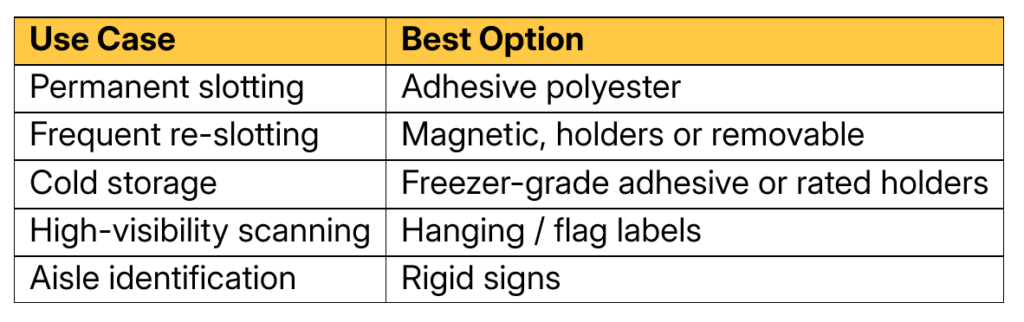
The selection of materials is also a crucial consideration determined by the requirements of your specific application. The table below outlines several use cases, followed by a detailed overview of common material options.
- Adhesive Labels (Most Common)
- Standard adhesive paper/poly labels
- Aggressive adhesive (cold‑storage rated)
- Polyester / vinyl
- Magnetic Labels
- Fast‑changing slotting
- Project ramps, temporary overflow
- Pilot areas
- Plastic Label Holders / Channels (Insert Cards)
- Snap‑on beam holders
- Clip‑on upright holders
- C‑channel strips
- Rigid Signs (PVC, Aluminum, Polycarbonate)
- End‑of‑aisle IDs
- Zone, pick path, or aisle markers
- High‑visibility reference locations
- Hanging / Flag Labels
- Plastic hang tags
- Flag or fin‑style labels
- Sleeve or Strap‑On Labels
- Odd beam profiles
- Temporary or test installs
- Rental or short‑term facilities
Creating accurate layout drawings, developing robust location numbering systems, and implementing a clear labeling system—including barcodes—forms the foundation for efficient warehouse operations. Whether your facility is small or large, these elements are not just helpful; they are vital for future growth, system upgrades, and operational excellence.
By implementing these best practices, you’ll enhance inventory accuracy, streamline material flow, and ensure your team is ready for any advancements. Investing in these fundamentals today sets your warehouse up for long-term success and adaptability in an evolving industry.
—Norm Saenz, St. Onge Company