Like many families living in colder states, we spend long winters indoors juggling school schedules, work commitments, and limited opportunities to travel. This year was no different for us. For months, my kids and I had been dreaming about a Florida vacation.
I envisioned a relaxing beach escape, while the kids were excited about snorkeling and boat trips. I wanted a relaxing beach escape. The kids were excited about snorkeling and boat trips.
One evening, we finally sat down together in the front of the Fireplace in a cold day to start planning seriously.
“How many days should we stay?” I asked.
“Five days!” they said excitedly.
“And we need at least one boat excursion,” I added.
Then came the real planning:
- Hotel costs
- Transportation
- Food expenses
- Activities and souvenirs
What I didn’t realize was that planning this vacation would become a perfect example of a SIOP (Sales, Inventory, and Operations Planning) process.
- Step 1: Forecasting Demand Just like a company forecasts customer demand, I was forecasting my family’s vacation requirements, how long we would stay, What the total trip would likely cost , I was essentially forecasting “family demand” for the vacation.
- Step 2: Checking Available Inventory
Next, I reviewed my resources. My “inventory” wasn’t products in a warehouse, it was: Vacation budget Available vacation days from work, Family savings Travel reward points After checking everything, I realized we had enough savings for the trip, but not enough for the luxury resort the kids had found online.
This is where SIOP thinking becomes powerful: aligning demand with actual available resources.
- Step 3: Creating the Operations Plan
We adjusted expectations and finalized a realistic plan:
- A comfortable beachfront hotel instead of a luxury resort
- Affordable flights
- One snorkeling trip instead of two
Everyone agreed, and the plan came together smoothly.
In SIOP terms:
Demand = Family expectations
- Inventory = Budget and available vacation time
- Operations = Travel bookings and itinerary
The plan was set.
The Disruption
Two weeks before departure, things changed.
A severe storm was forecast for the first two days of our trip.
Then came another issue, our airline rescheduled the flight, pushing arrival to late night and causing us to miss a planned snorkeling excursion.
Suddenly, the carefully balanced plan was no longer aligned.
Re-Planning Like a SIOP Team :Rather than panic, I followed a familiar planning cycle.
Reforecast
- Severe weather for two days
- New flight timing
- Reduced usable vacation time
Recheck Resources
- Could we extend the trip?
- Could activities be shifted?
- Was there budget flexibility?
Rebuild the Plan
After a few adjustments: Snorkeling was moved to Day 4 ,Indoor activities were planned during the storm, the hotel provided a small adjustment due to disruptions
The trip was back on track.
What is the new Outcome?
When we returned home, my kids said:
“Mom, that vacation was amazing, and It worked out even better than we expected.”
The kids never experienced the stress of the changes because everything had been re-planned in time.
What is the SIOP Lesson? This experience reinforced a simple but powerful truth:
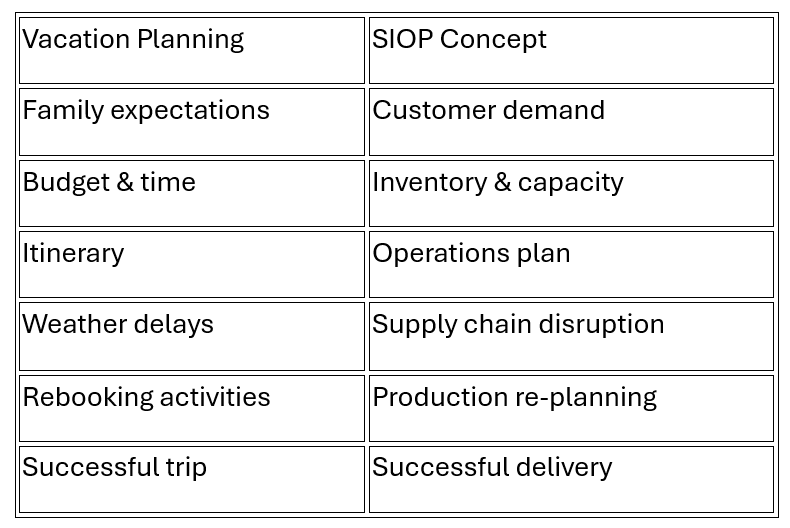
The goal of SIOP is not perfection. It is alignment, and the ability to adjust when reality changes.
Final Thought
Whether in business or in everyday life, the same principle applies:
Success comes from balancing demand, resources, and execution—while staying flexible when disruption occurs.
My family vacation was just one example. But the lesson carries everywhere:
SIOP thinking turns uncertainty into controlled, confident outcomes.
— Noha Youssef, St. Onge Company