Why the best supply chains are built by specialists, connected by generalists, and led by T-shaped leaders.
A couple of years ago, I read Range: Why Generalists Triumph in a Specialized World by David Epstein. The book has stayed with me longer than most, in part because so much of what it describes about complex, unpredictable environments feels like a direct reflection of the supply chain world I work in every day. But I’ll admit it also resonated on a more personal level. As someone who grew up as a multi-sport athlete before eventually competing at the highest levels in one, I saw a lot of my own path in Epstein’s research. The breadth I built early — across different sports, different coaches, different styles of play — turned out to be far more valuable to my development than I understood at the time. It shaped how I read the game, how I adapted under pressure, and ultimately how I performed once I did specialize.
Epstein’s central argument is that in “wicked” environments — the kind where rules are ambiguous, feedback is delayed, and outcomes depend on many interacting variables — people with broad experience often outperform those with narrow specialization. He contrasts figures like Roger Federer, who explored many sports before committing to tennis, with Tiger Woods, whose early and intense specialization is often held up as the singular path to greatness. Epstein’s research suggests that Federer’s path is far more common among high performers than we tend to assume, particularly in fields where breadth builds adaptability, creativity, and the ability to connect ideas across domains.
Supply chain, in many ways, is the ultimate wicked problem. A decision in one function ripples through the entire value chain. Forecasts affect production. Production affects inventory. Inventory affects distribution. Distribution affects transportation. Transportation affects customer experience. There are no isolated actions, only cascading consequences.
So it should come as no surprise that high-performing supply chain organizations are rarely built by specialists alone or generalists alone. They are built by leaders who intentionally design for both.
The Two Lenses: Optimizing the Function vs. Optimizing the System
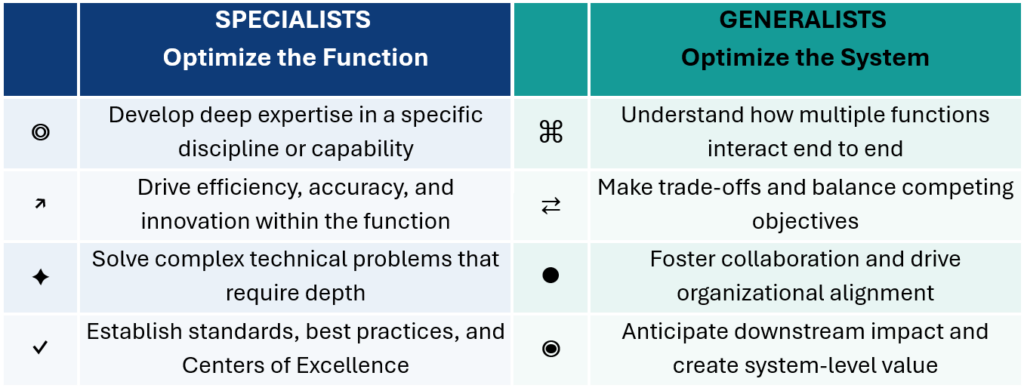
Specialists dive deep. They master a discipline, refine a methodology, and drive operational excellence within their domain. They are the people who understand the math behind safety stock calculations, the engineering behind material handling systems, or the configuration logic behind advanced planning software. Their expertise is what makes a specific function credible, defensible, and continuously improving.
Generalists, on the other hand, see across boundaries. They understand how trade-offs in one area shape outcomes in another and can translate between functions that too often speak different languages. If specialists understand the instruments, generalists understand the symphony. Both are necessary, and neither can substitute for the other.
The distinction is less about job titles than the primary lens each role brings to the organization:
When the balance between the two is right, performance accelerates. When the balance is off, dysfunction shows up in predictable ways.
The Risk of Too Many Specialists
One of the most common patterns I see in supply chain organizations is what I’d call “successful failure.” Every function is improving on its own metrics, yet the enterprise is quietly getting worse. Forecast accuracy inches upward, manufacturing utilization climbs, procurement lands lower unit costs, and transportation locks in better freight rates. Meanwhile, inventory keeps growing, service remains inconsistent, and working capital tightens.
When leadership investigates, they often find that every team is doing exactly what they were told to do. The problem isn’t performance. The problem is that no one is optimizing the system. Everyone is optimizing their piece of it. This is what happens when specialization outpaces integration.
The Risk of Too Many Generalists
The opposite problem is just as real, though less frequently discussed. Some organizations become so focused on strategy, transformation, and cross-functional visibility that they lose the technical depth required to actually improve anything. Conversations feel modern and forward-looking, filled with references to AI, control towers, and end-to-end orchestration. But underneath, the organization lacks the deep expertise needed to design an inventory policy, model a network, engineer a warehouse layout, or configure a planning system.
When this happens, decisions become shallow, initiatives lose rigor, and results plateau. Broad thinking without technical grounding produces momentum without traction.
Where Depth Tends to Matter Most
While there are no hard rules, certain roles in the supply chain naturally reward deep specialization. Network design is one of them — the modeling assumptions, optimization techniques, and data structures involved require significant technical fluency. The same is true for inventory optimization, where safety stock methodologies, service-level tradeoffs, and multi-echelon strategies are highly engineered disciplines. Facility design, automation, and material handling engineering also reward depth, as do the architects and configuration experts behind advanced planning systems and warehouse management platforms.
These are the roles where getting the math and mechanics right is the difference between a good outcome and a costly one. Generalists can recognize when this expertise is needed. Specialists are the ones who deliver it.
Where Breadth Tends to Matter Most
At the other end of the spectrum are the roles that thrive on integration. Supply chain leadership is perhaps the clearest example. A VP of Supply Chain does not need to be the best network modeler in the room, but they do need to understand how planning, procurement, manufacturing, distribution, transportation, technology, and finance interact — and how a decision in one area quietly reshapes the outcomes of another.
S&OP and IBP leaders play a similar role. They are essentially translators, bridging sales, marketing, finance, operations, and supply chain into a single, coherent conversation. Continuous improvement leaders and supply chain strategy teams also benefit from breadth, because their value comes from seeing patterns and connections that specialists, focused on their own domains, often cannot.
T-Shaped Talent: The Sweet Spot
If there’s a “so what” to all of this, it may be that the most valuable people in supply chain aren’t purely specialists or purely generalists. They’re what organizational designers have long referred to as T-shaped professionals — a concept generally attributed to David Guest and popularized by firms like IDEO and McKinsey in the 1990s. The vertical bar of the “T” represents deep expertise in a single domain. The horizontal bar represents the ability to collaborate, communicate, and connect across many.
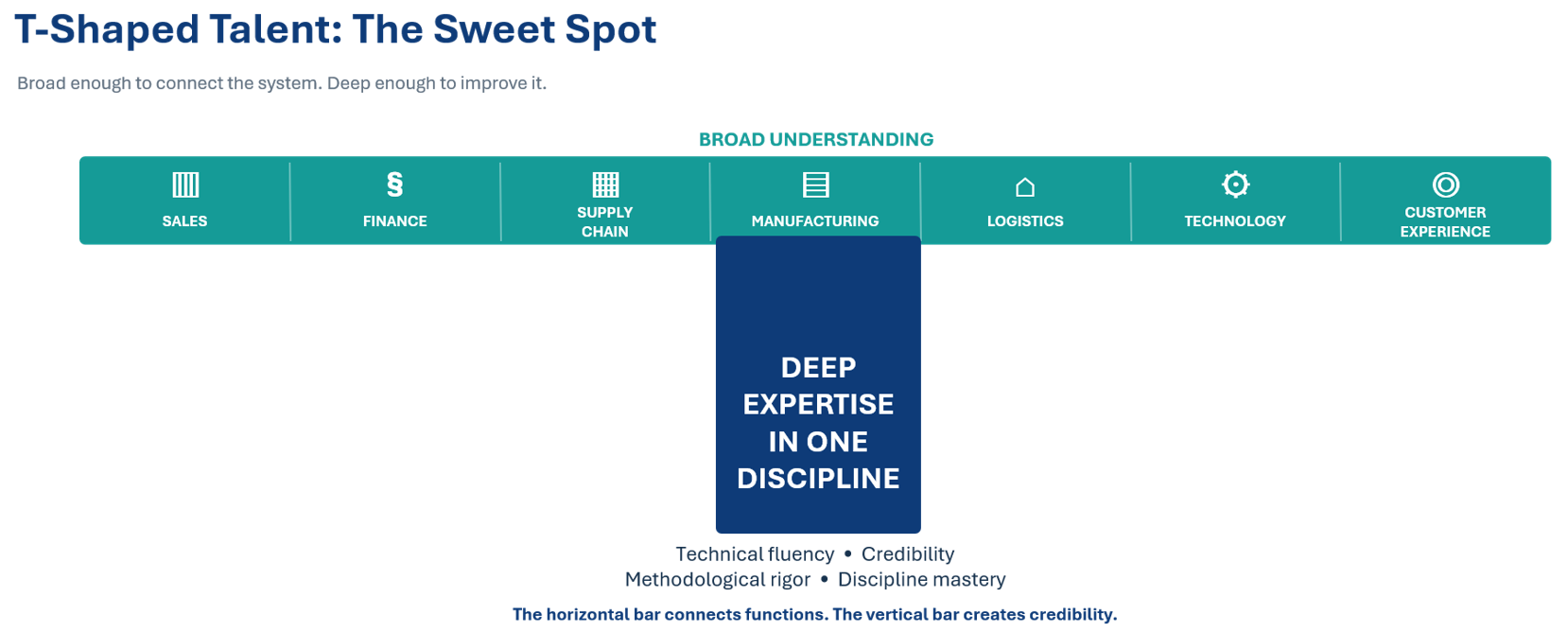
In practice, T-shaped leaders in supply chain look like the forecasting expert who also understands manufacturing constraints, the warehouse engineer who thinks about inventory policy, the planner who can hold their own in a finance conversation, or the transportation manager who fully appreciates the downstream impact on customer service. These are often the individuals who emerge as future executives — not because they know a little about everything, but because they know a lot about something and enough about everything else to lead across it.
Building more T-shaped talent is one of the most underrated investments an organization can make. It typically requires deliberate design: cross-functional rotations, exposure to adjacent disciplines, mentorship pairings that intentionally cross silos, and career paths that reward integration as much as they reward technical mastery.
Designing the Organization, Not Just the Process
Most supply chain transformation conversations focus on processes, technology, and data. Fewer focus on the people and structures that actually deliver those outcomes. Yet the organizations that pull ahead consistently share a common trait: they are intentional about where they build depth, where they build breadth, and how they connect the two.
They protect specialization in the roles that reward it. They cultivate generalists in the roles that require system-level thinking. And they invest in developing T-shaped leaders who can operate confidently in both worlds. This kind of design is less visible than a new WMS or a new S&OP process, but its impact often outlasts either of them.
It’s also, quite honestly, why our teams at St. Onge are built the way they are. Our engagements intentionally blend deep functional experts — in engineering, systems, inventory, and network design — with broad supply chain strategists who understand how those disciplines interact across the enterprise. We’ve seen firsthand that the best client outcomes rarely come from a single specialty. They come from pairing depth with perspective, and from designing engagements the same way we’d encourage our clients to design their own organizations.
If Range teaches us anything, it’s that breadth creates perspective. Supply chain teaches us that depth creates credibility. The strongest organizations don’t force people to choose between the two. They build environments where specialists can deepen their craft, generalists can connect the pieces, and T-shaped leaders can move fluidly between the details and the bigger picture.
Because in the end, supply chains aren’t won by the function with the smartest people. They’re won by the organizations that know how to connect expertise across the entire value chain.
—Kira Bilecky, St. Onge Company