Warehouse Management System (WMS) implementations entail continuous collaboration between both operational technology (OT) and information technology (IT) personnel. It is critical for senior leadership to have a deep understanding of their differences and unique requirements to create the environment for a successful implementation. The IT team’s primary objective is data management, software applications, and cybersecurity while ensuring the integrity and accessibility of data to support business operations. However, the OT team’s core objective is to oversee warehousing processes and devices in the supply chain and material handling industry. OT and IT team collaboration brings operational efficiency and improved productivity, and should be engaged at specific, strategic points throughout a WMS implementation. OT teams should be responsible for defining functional needs. IT teams are essential for determining technical success. See the OT/IT engagement throughout the various WMS implementation timeline phases in the table below:
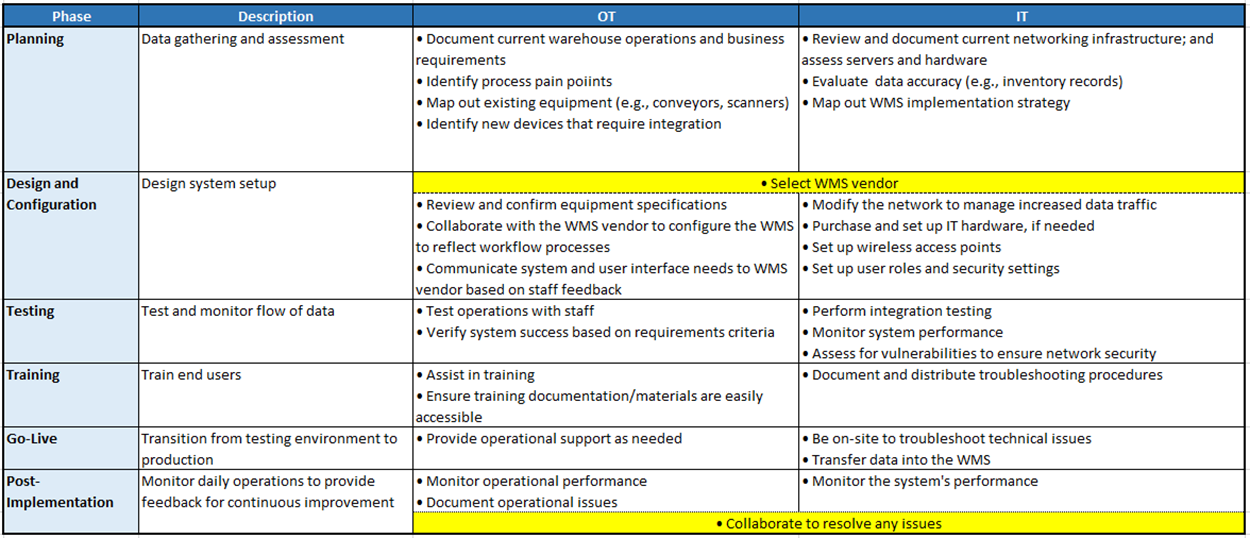
Establishing clear communication between OT and IT at the earliest stage, before vendor selection, will help avoid communication breakdowns and a lack of enthusiasm for implementing a new or upgraded WMS. The benefits of increased collaboration between OT and IT teams include:
- Increased competitive advantage by enhancing performance and productivity
- Avoid duplicate overhead costs
- Asset visibility
- Strengthened security
- Reduced unplanned downtime
- Faster troubleshooting
- Ensure compatibility of integrated systems
- Lower support costs
- Improved quality and compliance
- Enhanced technology advancements
- Increase revenue
- Informed decision-making and strategy planning
Implementing a WMS with a converged OT and IT team can present some challenges. Challenges can stem from differing priorities, change management strategy, expertise gaps, integration complexity, and resource constraints. As a result, OT can be resistant to change and experience system interruptions, and IT could be vulnerable to data breaches. To overcome these challenges, organizations can establish a steering committee to form common governance by standardizing processes, KPIs (e.g., productivity, quality), security guidelines (e.g., monitoring for anomalies), data collection, and skills (e.g., Solution Architect). Also, utilizing a RACI chart to assign clear roles and responsibilities to ensure adherence to the standards. Additional solutions are listed below:
- OT/IT goal alignment
- Invest in predictive maintenance
- Network segmentation
- Perform risk analysis of identified vulnerabilities and potential threats
- Create an incident escalation matrix chart
- Workforce training and awareness
Let’s walk through a scenario of what OT and IT collaboration looks like in the real world. In this scenario, a distribution center has decided to upgrade its current WMS to the latest version to integrate with a new automated conveyor system. The OT team is responsible for ensuring the automated conveyor belts, sensors, RF devices, and barcode scanners are operational. The IT team maintains cloud servers hosting the WMS and manages the integration between the WMS, automated conveyor, and enterprise resource planning (ERP) system. Both OT and IT teams are involved with the WMS implementation, predictive maintenance, troubleshooting, and cybersecurity. The convergence of OT and IT makes data sharing easier, which means real-time data can be acted upon much faster.
The successful implementation of warehouse automation software, including WMS solutions, revolves around the impact of organizational culture on the strategic functionality of the OT and IT teams. OT and IT collaboration provides a positive effect on achieving operational excellence, better decision-making, scalability, less downtime, and ensuring operations are secure. Consistent communication and collaboration are key to eliminating obstacles related to data management, regulatory compliance, and siloed approaches. The journey towards a fully integrated production environment, while reaping the benefits of digital transformation, leads to the ability to quickly respond to market shifts. Future-proofing operational efficiencies by aligning OT and IT teams will guarantee warehouse automation implementation success.
—Ashley Rhodes, St. Onge Company